
News
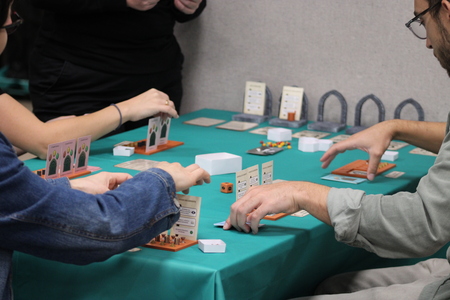
« LES HERITIERS DU SAVOIR » - a board game about participatory health research projects
- Unknown label,
- Unknown label,
Dates
from October 1, 2025 to July 31, 2026
"Remember: Knowledge does not wait for you, it is built and invented, here and now, with and through you!“
For the launch of the NEOLAiA Open Science Hub1, the university of Tours is unveiling the board game ”Les Héritiers du Savoir” (The Heirs of Knowledge), developed as part of Loire Val-Health, to the general public during the Science Festival at Tours City Hall on 11-12 October 2025. This game, specially designed as both a fun and educational tool, aims to raise public awareness and offer an immersive experience around the realities of participatory health research!
Ahead of this presentation, we met with Ilona Moutoussamy, creator of the game and project manager for the Loire Val-Health Caregiver-Patient Forum, to ask her about the origins of the project, its content and its prospects.
When I arrived here, I was told that one of my main tasks was to raise awareness of participatory research among caregivers, patients, researchers and doctors – in short, anyone who might one day be involved in participatory health research. I suggested several more or less traditional methods: posters, stands, kakemonos, presentations, etc. Then I mentioned that I liked more original, fun and engaging approaches, especially games. I suggested two options: an escape game or a board game. I got the go-ahead from my managers and started working on the board game, which I felt more inspired about. But the escape game is still in the back of our minds!
It's also worth noting that it's currently a game with a mediator. That means that for now, I have to be there to give the initial briefing, the final debriefing, etc. But eventually, we'd like everyone to be able to play freely, independently, with the mediation part integrated directly into the game, especially for the general public.
We have started presenting the game at stands to show that it exists, such as during continuing medical training days. During these presentations, participants asked us how much the game costs and where they can buy it. So clearly people like it, which is encouraging.
Indeed the game's development will depend a lot on the publisher's choice. There are two possibilities. Either we make an edition for training, with a limited number of boxes, intended for professionals in universities, museums, associations, etc. to create training games. In this case, the game will not be for the general public but will be used to raise awareness of participatory research. The game box will be more complex, with richer content. The second option is a “general public” edition, a lighter box, sold everywhere, so that everyone can use it, including professionals. For publishers, these are two completely different options, but for our part, we are considering a third alternative: a game for everyone that can also be used for training. A bit like the game Timeline, which is a classic game but can also be used as a ‘serious game’. We are also planning an educational booklet, like the game Kosmopolit developed by the publisher Opla in collaboration with a research laboratory in Lyon. So there are several possible directions.
Ahead of this presentation, we met with Ilona Moutoussamy, creator of the game and project manager for the Loire Val-Health Caregiver-Patient Forum, to ask her about the origins of the project, its content and its prospects.
1. Can you tell us about how the project came about? Where did you get the idea for a game about participatory health research?
I've always been making games, ever since I was little. I've always played a lot, whether it was video games or board games, and I've always loved building things. When I started my PhD, I designed two educational escape games for the Science Festival, as well as lots of little games, to the point where we ended up filling an entire room with them!When I arrived here, I was told that one of my main tasks was to raise awareness of participatory research among caregivers, patients, researchers and doctors – in short, anyone who might one day be involved in participatory health research. I suggested several more or less traditional methods: posters, stands, kakemonos, presentations, etc. Then I mentioned that I liked more original, fun and engaging approaches, especially games. I suggested two options: an escape game or a board game. I got the go-ahead from my managers and started working on the board game, which I felt more inspired about. But the escape game is still in the back of our minds!
2. Why did you choose a board game format rather than another educational tool?
As I said, I really like board games – but it should be noted that the whole team plays them a lot too. Everyone appreciates the serious side that can be brought to this type of game. It's a format we enjoy, so we use it a lot to attract crowds.3. Who is the target audience for your game? Students? Professionals? Citizens?
Everyone! The important thing is that everyone can play, which is something we really care about. The game is not aimed at a specific audience, and the goal is to raise awareness among as many people as possible. Of course, it is a bit complex; you need to be able to read and understand a few mechanisms, so it is a bit complicated for children. Children around the age of 14 can play it independently.It's also worth noting that it's currently a game with a mediator. That means that for now, I have to be there to give the initial briefing, the final debriefing, etc. But eventually, we'd like everyone to be able to play freely, independently, with the mediation part integrated directly into the game, especially for the general public.
4. Have you incorporated real experiences or stories into the game?
In the game, there is a quest to complete, and this quest is a participatory research project. For now, it is fictional because I had to quickly imagine and include it in the game to meet the deadline. But the goal is really to promote participatory health projects in the region. We want to base the quests and missions on real projects, even if they take place in an imaginary world. This will give us the opportunity to refer players to existing projects and anchor the game in reality.5. What feedback did you get from the first people who tested the game?
Very positive! The first version was presented in June, during INSERM's end-of-year day in Tours. I played three games with six players (six being the maximum) and got very good feedback. Some of them were even regular board game players and they gave me tips on how to improve the gameplay, so that was really great. We also presented it to the president of the university of Tours, and we played a game with him. He really enjoyed it and praised the initiative. So it's really encouraging for the future. And for the general public, testing will take place in the coming weeks, with the Science Festival in Tours and Orléans from 3 to 13 October 2025.We have started presenting the game at stands to show that it exists, such as during continuing medical training days. During these presentations, participants asked us how much the game costs and where they can buy it. So clearly people like it, which is encouraging.
6. How do you envisage the expansions and evolutions of the game ?
The first game box focuses on health because it was developed as part of the Loire Val-Health project. But if the project proves popular, we are open to the idea of creating themed expansions. We could work with laboratories in the region to take participatory research projects and turn them into quests. There are many projects on the environment and land use planning. So why not an ‘environment’ box, with new characters, new missions, etc. This is one possibility, which will also depend on discussions with the publisher and the public's response.Indeed the game's development will depend a lot on the publisher's choice. There are two possibilities. Either we make an edition for training, with a limited number of boxes, intended for professionals in universities, museums, associations, etc. to create training games. In this case, the game will not be for the general public but will be used to raise awareness of participatory research. The game box will be more complex, with richer content. The second option is a “general public” edition, a lighter box, sold everywhere, so that everyone can use it, including professionals. For publishers, these are two completely different options, but for our part, we are considering a third alternative: a game for everyone that can also be used for training. A bit like the game Timeline, which is a classic game but can also be used as a ‘serious game’. We are also planning an educational booklet, like the game Kosmopolit developed by the publisher Opla in collaboration with a research laboratory in Lyon. So there are several possible directions.